
Jev build · Model comparison

Jev beside chat models in an open-source signal benchmark.

  • Jev 1.14
  • Server v2 released 8 Nov 2026
  • 35 test windows
  • BTCUSDT, 22 Oct to 7 Nov 2026
  • Three baselines
  • One symbol, one interval

Haidar Ali maintains Trading Signal Server, an open-source project for comparing models on crypto market signals. In version 2 he added Jev: the server turns market data into a fixed set of options, Jev picks one, and code maps the pick to a direction and applies a fixed stop rule. Over 35 test windows of BTCUSDT one-hour candles from Binance, a Jev call took 2.21 seconds against 12.35 for GPT-6 Luna, and Jev gave the same direction on 96.9% of repeat calls against 62.9%. It is a benchmark of speed, tokens and calibration, and it is not trading advice.

Results

Speed and agreement,measured on live candles.

Each setup ran 35 test windows over the latest 400 one-hour BTCUSDT candles, fetched from Binance when the run started. A standalone run calls one model twice per window, and both answers must agree. The mixed run calls GPT-6 Luna once and Jev once.

  • 2.21 sper Jev call on average, against 12.35 s for GPT-6 Luna and 13.35 s for Qwen3-235B.
  • 13.13 sinference time per window with GPT-6 Luna plus Jev, against 24.70 s with two GPT-6 Luna calls (47% less).
  • 96.9%of Jev’s repeat calls agreed on direction. GPT-6 Luna: 62.9%. Qwen3-235B: 97.0%.
  • 0.263Brier score for Jev on the trade-success question, where lower is better. GPT-6 Luna: 0.214. Qwen3-235B: 0.257.
Jev alone against the chat modelsThe builder’s own
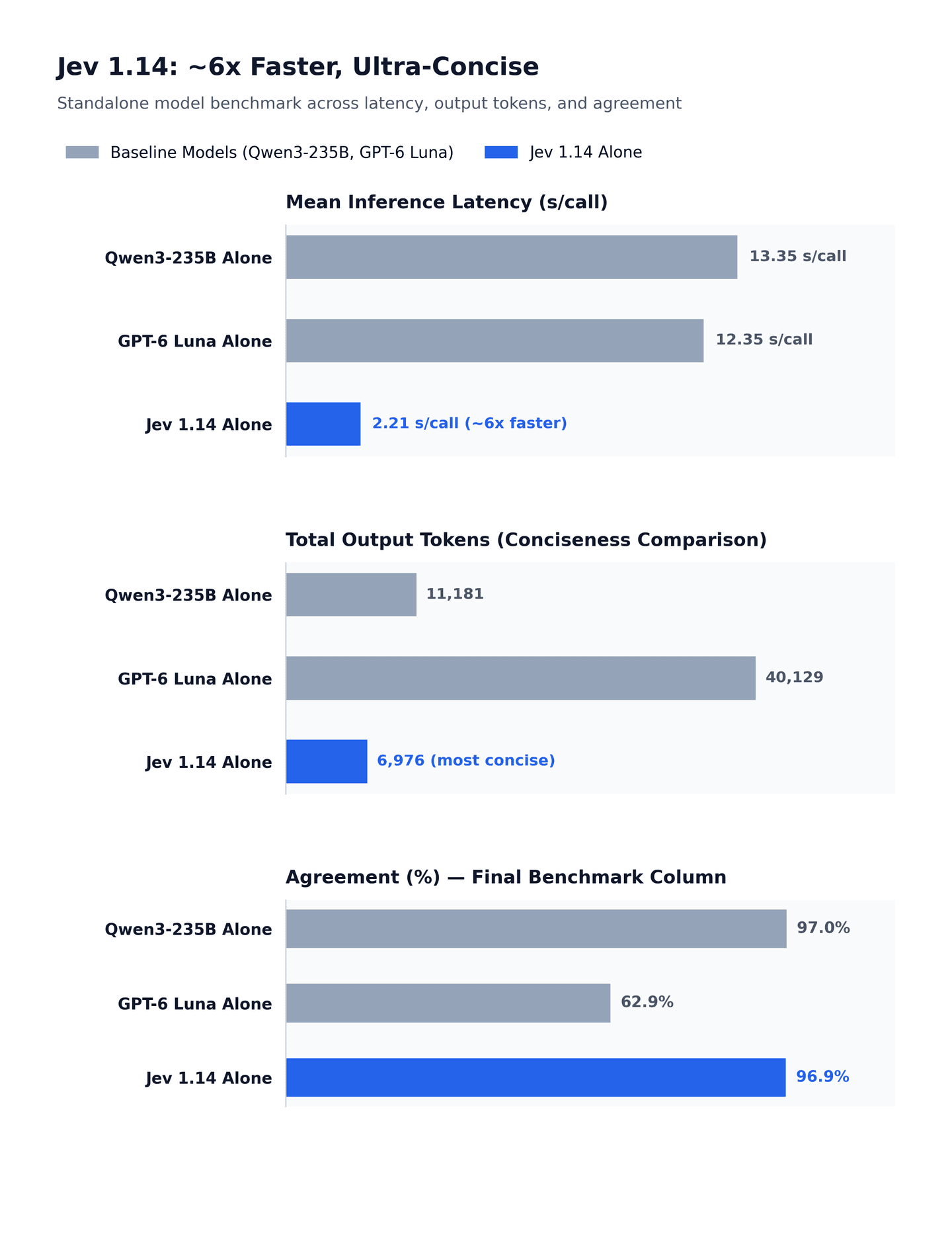
Bar charts from the builder, each model alone with two calls per window. Mean inference latency per call: Qwen3-235B 13.35 s, GPT-6 Luna 12.35 s, Jev 1.14 2.21 s. Total output tokens: 11,181, 40,129 and 6,976. Agreement between repeat calls: 97.0%, 62.9% and 96.9%.
The builder’s chart, from his README: time per call, output tokens and repeat-call agreement for each model alone, two calls per window over 35 test windows.
Jev as the second callThe builder’s own
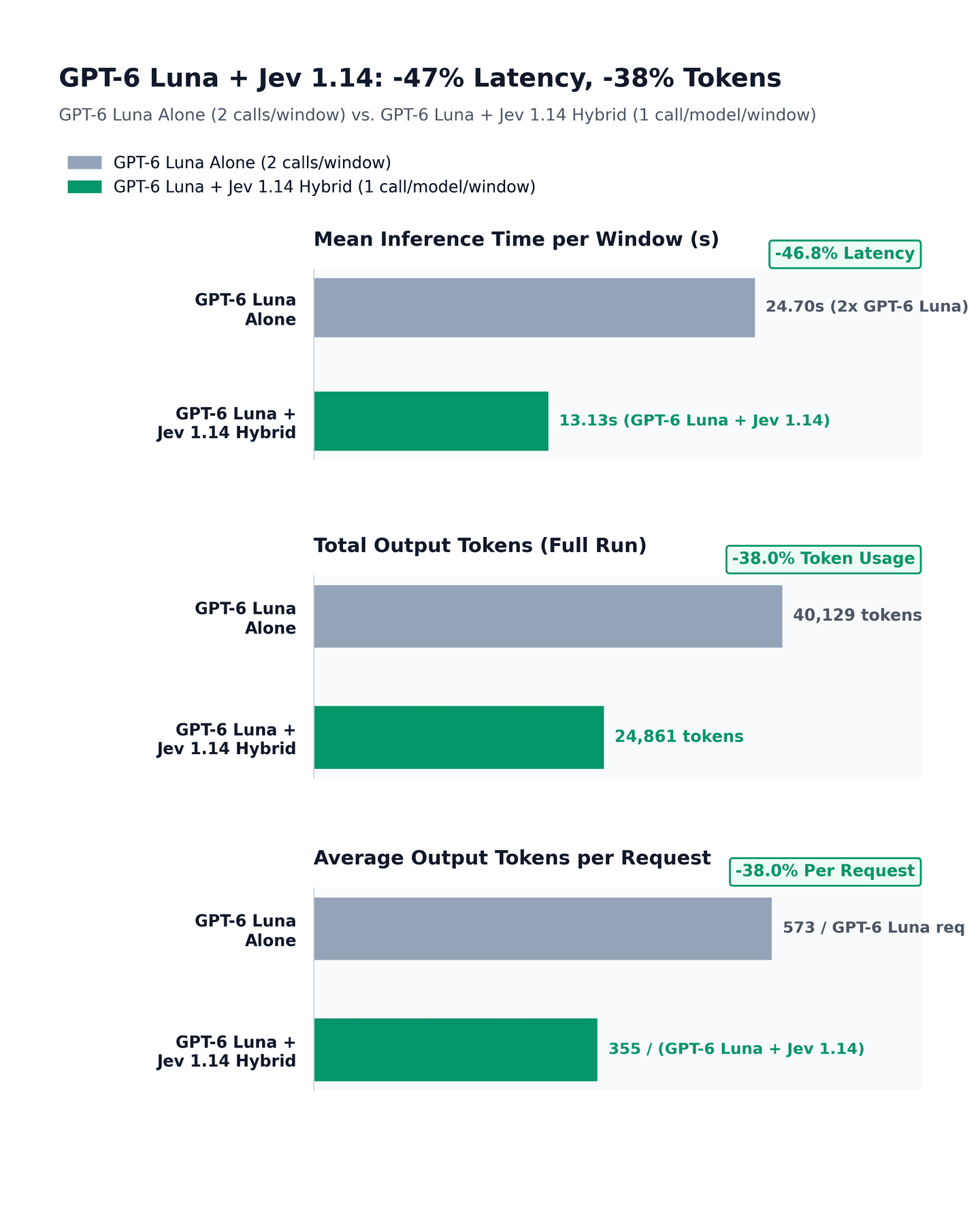
Bar charts from the builder comparing two GPT-6 Luna calls per window with one GPT-6 Luna call and one Jev 1.14 call. Mean inference time per window: 24.70 s against 13.13 s, 46.8% less. Total output tokens: 40,129 against 24,861. Average output tokens per request: 573 against 355, 38.0% less.
The builder’s chart, from his README: two GPT-6 Luna calls per window against one GPT-6 Luna call and one Jev call. In the mixed run the GPT-6 Luna call took 10.81 s and the Jev call 2.32 s.

Jev 1.14 alone, 2 calls per window

Mean inference latency
2.21 s per call
Output tokens
6,976
Repeat-call agreement
96.9%
Brier score (windows scored)
0.263 (28)

GPT-6 Luna alone, 2 calls per window

Mean inference latency
12.35 s per call
Output tokens
40,129
Repeat-call agreement
62.9%
Brier score (windows scored)
0.214 (32)

Qwen3-235B-A22B-2507 alone, 2 calls per window

Mean inference latency
13.35 s per call
Output tokens
11,181
Repeat-call agreement
97.0%
Brier score (windows scored)
0.257 (31)

GPT-6 Luna and Jev, 1 call each per window

Mean inference latency
GPT 10.81 s, Jev 2.32 s
Output tokens
24,861
Repeat-call agreement
n/a
Brier score (windows scored)
GPT 0.266 (34), Jev 0.267 (33)

The Brier score is computed on a separate question: the probability that the chosen option reaches its success condition within the evaluation horizon. In the mixed run the two models agreed in 68.6% of windows, which is a different measure from repeat-call agreement. Jev 1.14. Version 2 of the server was released on 8 November 2026, and the figures are the builder’s, from his README.

What Jev is asked

A pick,and a probability.

Jev is TypeSafe’s System One model, the kind of model most people call a decision model: it answers one narrow question with a typed answer and a probability.

  1. 01

    Which of these target levels?

    The server turns market data into typed options, in the built-in example Fibonacci target levels. Jev chooses one. Code maps the choice to a direction and applies a fixed stop rule.

  2. 02

    Will the chosen option reach its success condition within the horizon?

    A separate yes-or-no probability, asked only in backtests and scored with the Brier score. The probability of choosing an option is a different number.

Where Jev plugs inThe builder’s own
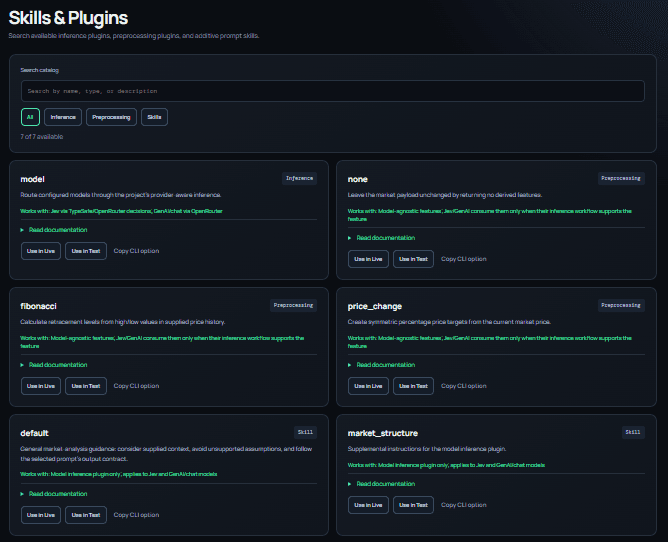
A screenshot of the server’s skills and plugins catalog: six cards, among them the model plugin, which routes configured models through the project’s provider-aware inference, and preprocessing plugins such as fibonacci and price_change.
The server’s plugin catalog, from the builder’s repository. The model plugin’s card reads: “Works with: Jev via TypeSafe/OpenRouter decisions, GenAI/chat via OpenRouter.”

What it showed

Fast and repeatable.No better calibrated.

  1. 01

    Jev’s clearest strengths were speed and repeatability.

    About 2 seconds a call against 12 to 13 for the chat models. It gave the same direction on 96.9% of repeat calls, level with Qwen3-235B (97.0%) and well above GPT-6 Luna (62.9%).

  2. 02

    Its probabilities were no better.

    On the trade-success question GPT-6 Luna had the best Brier score (0.214). Jev’s was 0.263, and in the mixed run GPT-6 Luna’s own score was worse (0.266) than when it ran alone.

  3. 03

    As the second call, Jev halved the wait.

    With one GPT-6 Luna call and one Jev call per window in place of two GPT-6 Luna calls, inference time per window fell from 24.70 s to 13.13 s (47%) and output tokens from 40,129 to 24,861 (38%).

How it was measured

35 test windowson Binance candles.

  • The data.

    BTCUSDT one-hour candles, the latest 400 fetched from Binance when each run started, in 35 test windows. Each run steps through them in order, with later candles hidden at every point. The standalone runs cover 06:00 on 22 October to 21:00 on 7 November 2026 (UTC); the GPT-6 Luna and Jev run starts and ends two candles later. The saved run settings are in the repository, so the runs can be repeated.

  • The setups.

    Jev 1.14 alone, GPT-6 Luna alone and Qwen3-235B-A22B-2507 (qwen/qwen3-235b-a22b-2507) alone, each called twice per window, and GPT-6 Luna with Jev, one call each.

  • The measures.

    Mean inference latency, output tokens, agreement between calls, and the Brier score of each model’s trade-success probability, with the number of windows scored.

Limits

What the testdoes not show.

  • This is a benchmark of models on one symbol over about two weeks of market data. It is not trading advice, and nothing here predicts future results.

  • The sample is small: 400 candles and 35 test windows, on one symbol and one interval.

  • The mixed run starts and ends two candles later than the standalone runs, so that comparison is not controlled. The builder reads it as a sign that Jev may complement a chat model, and not as proof.

Code and sources

Read the codeand the tables.

Who built it

The engineerbehind this build.

Haidar Ali

Haidar Ali

AI/ML Engineer · Syria

Haidar built version 2 of his server, added the Jev workflow and ran the comparisons.

He is a machine learning engineer at Deep Torch and has 1.3 years of experience in medical AI at Ntigra, a UAE-based company. He holds a bachelor’s degree in artificial intelligence from Tishreen University.

Next step

Have a decision like this one?

A short call on what gets decided, how often, and what a wrong answer costs.

Book a call