
Jev build · Document search

Jev walks a PDF’s table of contents to find the answer.

  • jev-1.13.0
  • Run 10 Nov 2026
  • 20 questions, 4 PDFs
  • 3 runs per question
  • Two baselines
  • Apache 2.0 code

Gassyr Bakubay built a search that treats a long PDF’s own table of contents as a tree. Jev ranks the sections, checks the pages in the most promising one, and stops once it judges that nothing the question needs is missing. On 20 questions over 4 long PDFs it returned pages that support the correct answer in 59 of 60 runs, at about one-thirteenth the cost of an OpenAI model walking the same contents.

Results

Three ways to findthe pages, compared.

All three approaches got the same parsed pages, the same table of contents and the same limits. None wrote an answer. Each returned pages.

  • 59 of 60runs in which Jev’s walk returned pages that support the correct answer. Checking every page and the OpenAI model: 60 of 60.
  • 13xlower cost per question than the OpenAI model walking the same contents ($0.0045 against $0.058).
  • 2.6xfaster per question than the OpenAI model (4.8 s against 12.4 s, medians).
  • About halfthe pages read, against checking every page (62 against 116 on average).
Three ways to find the pages, measuredMeasured
From the builder’s results: 20 questions over 4 PDFs, 3 runs each, jev-1.13.0 and OpenAI’s gpt-6.1-sol, 10 November 2026. A run counts when its pages contain everything the answer needs. Pages read and cost are averages; time is a median.

Jev walks the contents

Answer supported
59 of 60 runs
Pages read
62
Cost per question
$0.0045
Time per question
4.8 s

Jev checks every page

Answer supported
60 of 60 runs
Pages read
116
Cost per question
$0.0056
Time per question
5.3 s

OpenAI model (gpt-6.1-sol) walks the contents

Answer supported
60 of 60 runs
Pages read
10
Cost per question
$0.058
Time per question
12.4 s

“Answer supported” counts the runs whose returned pages contain everything needed for the question’s gold answer. Pages read and cost are averages over the questions, and time is a median. Costs use list prices: Jev at $0.042 per million input tokens, gpt-6.1-sol at $2 per million input tokens and $10 per million output tokens. Jev version jev-1.13.0, all runs on 10 November 2026. The figures are the builder’s.

One question, three ways

One recorded run of each approach on “How does Amazon recognize lease costs?” (Amazon’s 2017 annual report, 85 pages, answer on page 47), shown at real speed. Video by Gassyr Bakubay.

What Jev is asked

Three narrowjudgments.

Jev is TypeSafe’s System One model, the kind of model most people call a decision model: it answers one narrow question with a typed answer and a probability.

  1. 01

    Which section is most likely to hold the answer?

    At each level of the table of contents, Jev picks among the section titles. The ranking only orders the walk. No section is dropped for good.

  2. 02

    Does this page state evidence the question needs?

    Asked once per page, read with the page before and the page after as context. A page is returned only on its own score.

  3. 03

    Is anything the question needs still missing?

    Asked of the pages selected so far. Once Jev judges that nothing is missing (a score of 0.85 or higher), the walk stops. If it never does, the walk reaches every page.

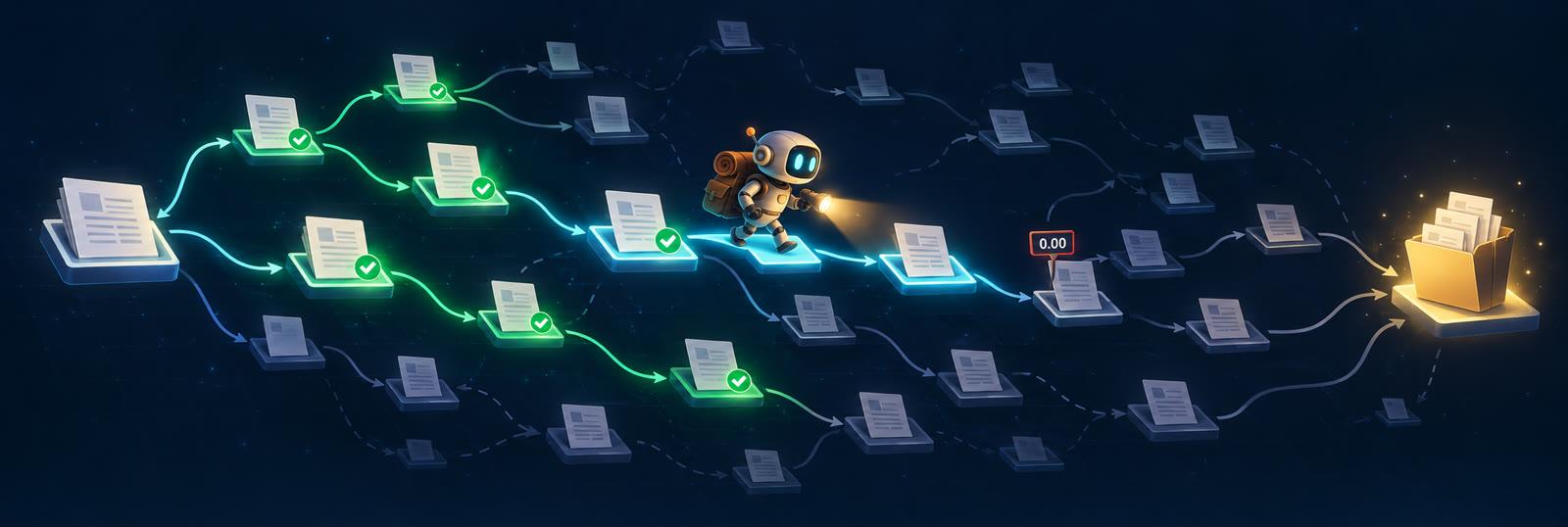
The walk, as the builder pictures itThe builder’s own
An illustration of a small robot walking a branching tree of document pages: pages it has checked lit green behind it, a page scored 0.00 ahead, and a folder of collected pages at the end.
The header of the builder’s repository: pages checked branch by branch, until the evidence is in.

How it was measured

Twenty questions,four long PDFs.

  • The documents.

    Four PDFs from the public PageIndex-OSS-Benchmark, each with a real printed table of contents: three annual reports (Amazon 2017, Best Buy 2023, Activision Blizzard 2019) and one coffee-machine manual, 75 to 198 pages each.

  • The questions.

    Twenty, each with a gold answer and annotated evidence pages. Eight are the benchmark’s own and twelve come from MMLongBench-Doc-V2 on the same PDFs. Eleven are answered on one page and nine need two, mostly ratios.

  • The comparison.

    Jev walking the contents, Jev checking every page with no tree and no stop decision, and an OpenAI model (gpt-6.1-sol) walking the same contents by itself. All three read at most 8 complete pages (12,000 tokens) at a time and sent one request at a time.

  • The runs.

    Each approach ran every question three times: 60 runs each and 180 in all, with no failed runs. The gold answers were used only after retrieval had finished.

Limits

What the testdoes not show.

  • It covers 20 questions on 4 documents with clean tables of contents, and has no baseline outside the tree, such as embedding search.

  • The stop cutoff of 0.85 was set on these same questions, so the figures for Jev’s walk may be slightly optimistic.

  • In 20 of the 60 runs Jev never judged the evidence complete and walked the whole document. Those runs cost about 1.5 times as much as checking every page.

  • The one miss was a ratio that needs two pages: Jev found the first number, judged that nothing was missing, and stopped.

  • Pages that hold the same answer as the annotated ones were accepted as correct. An AI assistant checked them against the gold answers. Independent reviewers did not.

  • The PDF needs a table of contents whose titles mean something. “Part I, Part II” gives Jev nothing to judge.

Code and sources

Read the codeand the report.

Who built it

The engineerbehind this build.

Gassyr Bakubay

Gassyr Bakubay

Applied AI & Software Engineer · Hong Kong

Gassyr designed the search, built both baselines and ran the comparison.

He builds AI document automation for the construction industry at Pyramid AI in Hong Kong. Before that he led engineering at Profind.ai, founded AQL Labs and worked on microservices at Lalamove. He holds a BSc in Computer Science from Hong Kong Baptist University.

Next step

Have a decision like this one?

A short call on what gets decided, how often, and what a wrong answer costs.

Book a call