
Jev build · Fact checking

Jev decides whether an edited document still supports a stored fact.

  • Jev 1.14
  • Run 5 and 6 Nov 2026
  • 172 test cases
  • Three LLM judges
  • 95% intervals
  • Code and data private

Iurii Dremov builds a memory system for teams. It takes in documents, chats and meeting notes, extracts facts with their sources, and stores them in a knowledge graph. When a document is edited, a judge has to decide whether the new text still supports each fact. He measured Jev in that job on 172 hand-labeled cases, alone and as a first pass that hands the cases it is unsure of to an LLM judge. At a confidence of 0.85 or more, Jev decided 37% of the cases by itself and was right on 91% of them.

Results

Jev alone,and in front of a judge.

Every model read the same text and answered with one of four verdicts. In the cascade Jev answers first, and its verdict stands when its confidence is 0.85 or more. The LLM judge decides the rest.

  • 37%of the 172 cases decided by Jev alone at a confidence of 0.85 or more (95% interval 30 to 44%).
  • 91%of those decisions were right (95% interval 83 to 97%).
  • 1 caseof 172: with each judge, the cascade’s verdict accuracy stayed within one case of the judge alone.
  • 29 to 31%lower cost in front of GPT-6.1 Terra or Claude Sonnet 5.5. In front of GPT-6 Luna the cost was 20% higher.
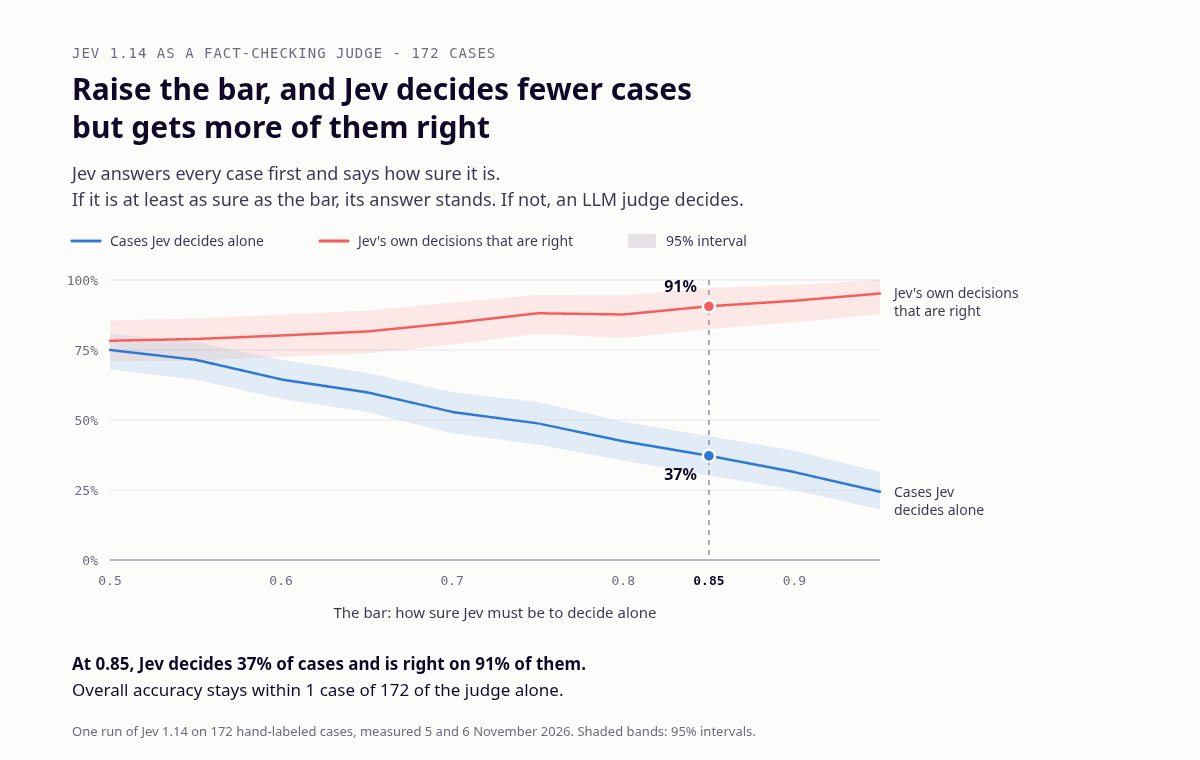
Raise the bar, and Jev decides fewer casesThe builder’s own
Line chart from the builder. As the confidence Jev needs rises from 0.5 to 0.95, the share of cases it decides alone falls from about 75% to about 25%, and the share of its own decisions that are right rises from about 78% to about 95%. At 0.85, Jev decides 37% of cases and is right on 91% of them.
The builder’s chart: the share of cases Jev decides alone, and how often those decisions are right, as the confidence it needs rises. This page’s figures are at 0.85. One run of Jev 1.14 on the 172 cases; the bands are 95% intervals.
Cost per 1,000 decisions: the judge alone, and with Jev firstMeasured
At a confidence threshold of 0.85; each pairing is one Jev run with the judge’s first run, at list prices. The figures are the builder’s, measured 5 and 6 November 2026.

GPT-6 Luna

Jev decides
37%
Jev right when it decides
91%
Verdict accuracy: cascade / judge alone
0.692 / 0.698
Cost per 1,000 decisions: cascade / judge alone
$0.206 / $0.172

GPT-6.1 Terra

Jev decides
39%
Jev right when it decides
91%
Verdict accuracy: cascade / judge alone
0.721 / 0.721
Cost per 1,000 decisions: cascade / judge alone
$1.21 / $1.70

Claude Sonnet 5.5

Jev decides
37%
Jev right when it decides
92%
Verdict accuracy: cascade / judge alone
0.727 / 0.727
Cost per 1,000 decisions: cascade / judge alone
$3.96 / $5.72

Each row pairs one Jev run with the judge’s first run. Costs use list prices per million tokens in and out: GPT-6 Luna $0.10 and $0.50, GPT-6.1 Terra $1 and $5, Claude Sonnet 5.5 $2 and $10, Jev $0.042 for input only. The three LLM judges ran without reasoning. Jev 1.14, measured on 5 and 6 November 2026. The figures are the builder’s.

  • Alone, Jev matched GPT-6 Luna, the judge the system uses in production.

    Verdict accuracy of 0.69 to 0.72 against 0.67 to 0.70, at $0.09 against $0.17 per 1,000 decisions and 0.3 s against 2.5 to 2.8 s per answer. On the decision to flag a fact, GPT-6.1 Terra and Claude Sonnet 5.5 were ahead of both, with a balanced accuracy of 0.86 and 0.83: the average of the share of drifted facts flagged and the share of sound facts left alone.

  • Its confidence matched its accuracy.

    Jev said 0.69 on average and was right on 69 to 72% of cases. GPT-6 Luna and GPT-6.1 Terra said 0.98 and were right on 67 to 72%.

What Jev is asked

One question,four verdicts.

Jev is TypeSafe’s System One model, the kind of model most people call a decision model: it answers one narrow question with a typed answer and a probability.

  1. 01

    Does the new text still support this fact?

    One choice question per case, on the same text the LLM judge reads. The options are supported, contradicted, unmentioned (the fact’s text was removed) and cannot tell.

  2. 02

    The probability decides who answers.

    In the cascade, a verdict at 0.85 or more stands and anything lower goes to the LLM judge. In production, a contradicted or unmentioned verdict at 0.6 or more flags the fact as drifted. A flag can close the fact, so a false flag is the costly error.

The cascade, at a confidence of 0.85Measured
Jev 1.14, measured 5 and 6 November 2026, shown with GPT-6 Luna as the judge. With GPT-6.1 Terra and Claude Sonnet 5.5, Jev decided 39% and 37% of cases, 91% and 92% of them right. The figures are the builder’s.

What it showed

Cheaper in front of a costlyjudge. No fewer errors.

  1. 01

    Jev and the LLM judges fail on the same cases.

    Where Jev was wrong, the judge was wrong too in 56 to 81% of those cases, against 27 to 33% of all cases. So putting Jev in front does not remove the judge’s errors.

  2. 02

    It pays off only in front of a costlier judge.

    The cases Jev passes on are the longer ones and carry 66 to 68% of the judge’s cost. In front of GPT-6 Luna the cascade cost 20% more. It pays off with a judge above about $0.27 per 1,000 decisions.

  3. 03

    The 0.6 floor drops a third of Jev’s drift verdicts.

    In production a drift verdict below a confidence of 0.6 is not acted on. The LLM judges almost never answer below that, and a third of Jev’s drift verdicts do: under the rule Jev caught 57 to 61 of the 113 drifted facts, and 83 to 88 without it.

What each model said, and how often it was rightMeasured
Mean stated confidence and verdict accuracy on the 172 cases. Accuracy ranges span the runs: Jev 8, GPT-6 Luna 6, GPT-6.1 Terra 2, Claude Sonnet 5.5 1. Stated confidence above the share right is overconfidence. The figures are the builder’s, measured 5 and 6 November 2026.

How it was measured

172 cases fromreal documentation.

  • The cases.

    184 hand-labeled cases from the documentation of two internal projects. Rules settle 12 before any judge. Of the other 172, 32 were written by hand and 140 came from production: 70 that the production judge had got wrong or left open, and 70 random production closures.

  • The right answers.

    113 of the 172 should be flagged as drifted and 59 should not. 50 of those 59 are paraphrases of the fact.

  • The models.

    Jev 1.14 with one choice question. GPT-6 Luna, the production judge, plus GPT-6.1 Terra and Claude Sonnet 5.5, all without reasoning.

  • The runs.

    Jev ran 8 times, GPT-6 Luna 6, GPT-6.1 Terra 2 and Claude Sonnet 5.5 once. Ranges span the runs, and intervals are 95% bootstrap intervals over cases. Timing is from one client over the public internet, one call at a time.

Limits

What the testdoes not show.

  • The thresholds were chosen on the same 172 cases, so a fixed threshold on new data will do worse.

  • The set is skewed to hard cases. How many routine checks Jev would settle was not measured.

  • One domain: software documentation and project notes.

  • Verdict accuracy does not separate the four models. One run’s interval is about 0.07 either way, so they overlap.

  • Jev gives no written reason for a verdict.

  • The code and the test cases are private, so these figures cannot be re-run from this page.

Sources

What is public,and what is not.

Who built it

The engineerbehind this build.

Iurii Dremov

Iurii Dremov

Product AI Engineer · Uruguay

Iurii designed the comparison, ran Jev and the three LLM judges, and wrote the report.

He is a Product AI Engineer at Profesoria and was Lead Python Developer at plai tennis before that. He has more than 10 years in software development, 6 of them in Python and 4 building real-time machine learning and computer vision pipelines. He holds a bachelor’s degree in applied mathematics from Southern Federal University.

Next step

Have a decision like this one?

A short call on what gets decided, how often, and what a wrong answer costs.

Book a call