
Jev build · Classification
Jev sorts payment fraud alerts into five types, against GPT-4o-mini.
- jev-1.14.0
- Run 8 Nov 2026
- 500 test alerts
- Five alert types
- Simulated data
- MIT code
A payment fraud alert needs an answer while the payment is still in flight: which type of fraud it looks like, and whether to hold it. Anuar Sultan built a benchmark of 500 simulated alerts and gave Jev and GPT-4o-mini the same alerts and the same written criteria. Jev reached a macro F1 of 0.891, against 0.474 for GPT-4o-mini answering directly and 0.577 when it reasoned first. A model trained on 10,000 similar alerts reached 0.960.
Results
Two models, two referencepoints, the same 500 alerts.
Jev and GPT-4o-mini got the same alert and the same criteria text. Two reference points frame them: the if-then rules an analyst would write from those criteria, and a gradient-boosting model trained on 10,000 separate alerts.
- 0.891macro F1 for Jev (95% interval 0.864 to 0.914). GPT-4o-mini: 0.474 answering directly, 0.577 reasoning first.
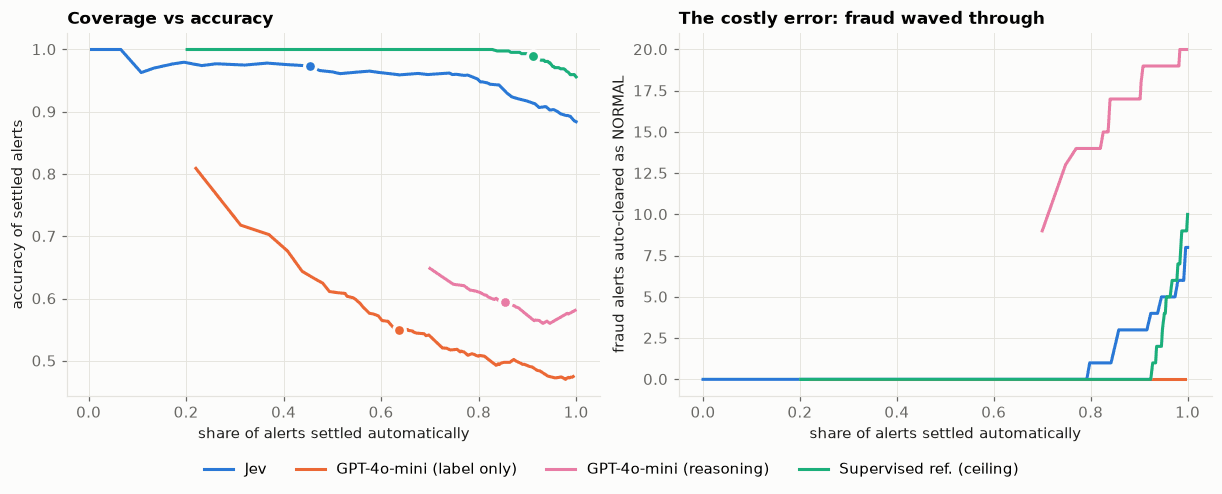
- 47%of alerts settled automatically at a probability of 0.85 or more, 96.6% of them correctly. No fraud was cleared as normal.
- 336 msP90 latency with 8 calls in flight. GPT-4o-mini: 1,153 ms answering directly, 3,890 ms reasoning first.
- $0.045per 1,000 alerts, against $0.113 and $0.190 for GPT-4o-mini.
Five approaches, the same 500 alertsMeasured
Macro F1
- Trained model (10,000 alerts)0.960
- Jev0.891
- Analyst rules0.831
- GPT-4o-mini, answering directly0.474
- GPT-4o-mini, reasoning first0.577
Settled without an analyst (probability 0.85 or more)
- Trained model (10,000 alerts)91%
- Jev47%
- GPT-4o-mini, answering directly65%
- GPT-4o-mini, reasoning first86%
Right when settled
- Trained model (10,000 alerts)98.9%
- Jev96.6%
- GPT-4o-mini, answering directly55.2%
- GPT-4o-mini, reasoning first59.3%
| Measure | Jev | GPT-4o-mini, label only | GPT-4o-mini, reasoning first | Analyst rules | Trained model |
|---|---|---|---|---|---|
| Macro F1 | 0.891 | 0.474 | 0.577 | 0.831 | 0.960 |
| Accuracy | 88.4% | 47.8% | 58.2% | 82.8% | 95.6% |
| Settled at 0.85 or more (share right) | 47% (96.6%) | 65% (55.2%) | 86% (59.3%) | n/a | 91% (98.9%) |
| Fraud cleared as normal when settled | 0 | 0 | 17 | n/a | 0 |
| P90 latency | 336 ms | 1,153 ms | 3,890 ms | n/a | n/a |
| Cost per 1,000 alerts | $0.045 | $0.113 | $0.190 | n/a | n/a |
Macro F1
- Jev
- 0.891
- GPT-4o-mini, label only
- 0.474
- GPT-4o-mini, reasoning first
- 0.577
- Analyst rules
- 0.831
- Trained model
- 0.960
Accuracy
- Jev
- 88.4%
- GPT-4o-mini, label only
- 47.8%
- GPT-4o-mini, reasoning first
- 58.2%
- Analyst rules
- 82.8%
- Trained model
- 95.6%
Settled at 0.85 or more (share right)
- Jev
- 47% (96.6%)
- GPT-4o-mini, label only
- 65% (55.2%)
- GPT-4o-mini, reasoning first
- 86% (59.3%)
- Analyst rules
- n/a
- Trained model
- 91% (98.9%)
Fraud cleared as normal when settled
- Jev
- 0
- GPT-4o-mini, label only
- 0
- GPT-4o-mini, reasoning first
- 17
- Analyst rules
- n/a
- Trained model
- 0
P90 latency
- Jev
- 336 ms
- GPT-4o-mini, label only
- 1,153 ms
- GPT-4o-mini, reasoning first
- 3,890 ms
- Analyst rules
- n/a
- Trained model
- n/a
Cost per 1,000 alerts
- Jev
- $0.045
- GPT-4o-mini, label only
- $0.113
- GPT-4o-mini, reasoning first
- $0.190
- Analyst rules
- n/a
- Trained model
- n/a
GPT-4o-mini is gpt-4o-mini-2024-07-18 at temperature 0, and its class probabilities are read from token log-probabilities. The trained model is gradient boosting trained on 10,000 separate simulated alerts: a practical upper bound that a model given only the criteria is not expected to reach. Latency is client time measured from Almaty. Jev version jev-1.14.0, run on 8 November 2026. The figures are the builder’s.
What Jev is asked
Two questionsin one request.
Jev is TypeSafe’s System One model, the kind of model most people call a decision model: it answers one narrow question with a typed answer and a probability.
- 01
Which type of alert is this?
A choice among five: normal, money mule, account takeover, synthetic identity and structuring. Jev returns a probability for each.
- 02
Should the payment be held for review before it settles?
A yes-or-no probability. The payment is released at 0.30 or less, held at 0.70 or more, and sent to an analyst in between.
- 03
When the answer stands.
An alert is settled automatically when the probability of the chosen type is 0.85 or more. The rest go to a person.
What it showed
One label namemoved a model 20 points.
- 01
The first run used a label that misled both models.
Version 1 called one type CASH_OUT_FRAUD. On the 500 test alerts GPT-4o-mini reached 27.0% accuracy, because it matched that label to the dataset’s CASH_OUT transaction type. Jev reached 85.4%, with a milder version of the same confusion.
- 02
The rename was decided on the development alerts.
The label became MONEY_MULE for both models. On the 100 development alerts the rename alone took Jev’s accuracy from 88% to 91% and GPT-4o-mini’s from 26% to 46%. The test alerts were then run once more. Both runs are in the repository.
- 03
Where Jev is weak.
It labels some legitimate large transfers as money mules (precision 0.74 on that type, where the analyst rules do better), and one in five legitimate alerts gets a fraud label. Payroll split into transfers just under a threshold scored 0 of 6.
- 04
Jev repeated itself more often.
Asked the same 150 alerts twice, Jev gave the same label 146 times. GPT-4o-mini at temperature 0 matched itself 132 times answering directly and 111 times reasoning first.
Settling more alerts, and what it costsThe builder’s own
How it was measured
500 simulated alerts,built on public data.
The transactions.
Unmodified rows from PaySim, a public simulated mobile-money dataset. PaySim’s own fraud flags are never shown to a model.
The signals and labels.
Each alert gets 19 session, device, identity and velocity signals, generated from one of 17 written scenarios across the five types. The label is the scenario that generated the alert. Some scenarios are look-alikes on purpose, such as a phone upgrade followed by a large payment against a quiet account takeover.
The splits.
500 test alerts are the reported benchmark. A separate 100 development alerts were the only ones used to word the criteria, and 10,000 more trained the reference model.
The rules of measurement.
Failed calls count as misses. Both models ran through one client with the same timeouts and retries, their calls interleaved in random order. Each report records the code version, the data and criteria hashes and the model versions served.
Limits
What the testdoes not show.
The alerts are simulated. The results describe this task and say nothing about fraud-detection rates at a real institution.
The generated signals decide most labels: a model trained on the 19 signals alone reaches 92.6% accuracy.
GPT-4o-mini was the baseline fixed before the run. It is not the newest small language model.
With the suggested hold band, Jev sends 207 of the 500 alerts (41%) to an analyst. The band was not tuned.
500 test alerts give intervals of several points on each type’s F1.
Latency depends on where the client runs. These figures are from Almaty.
Code and sources
Read the codeand the report.
- Code · MITcpipi/fraud-triage-jevThe alert generator, the benchmark runner, both clients, the reference models, the reports and the tests.
- ReportFraud alert triage: Jev vs GPT-4o-miniThe full results of the main run: every model with intervals, precision and recall per type, and paired differences.
- DataPaySimThe public simulated mobile-money dataset the transactions come from (Lopez-Rojas et al., 2016).
Who built it
The engineerbehind this build.
Next step