
Jev build · Contract review

Jev decides which contract clauses an expensive model never has to read.

  • jev-1.14.0
  • Run 13 Nov 2026
  • 53 agreements
  • 3,246 clauses
  • 378 marked provisions
  • Six rules

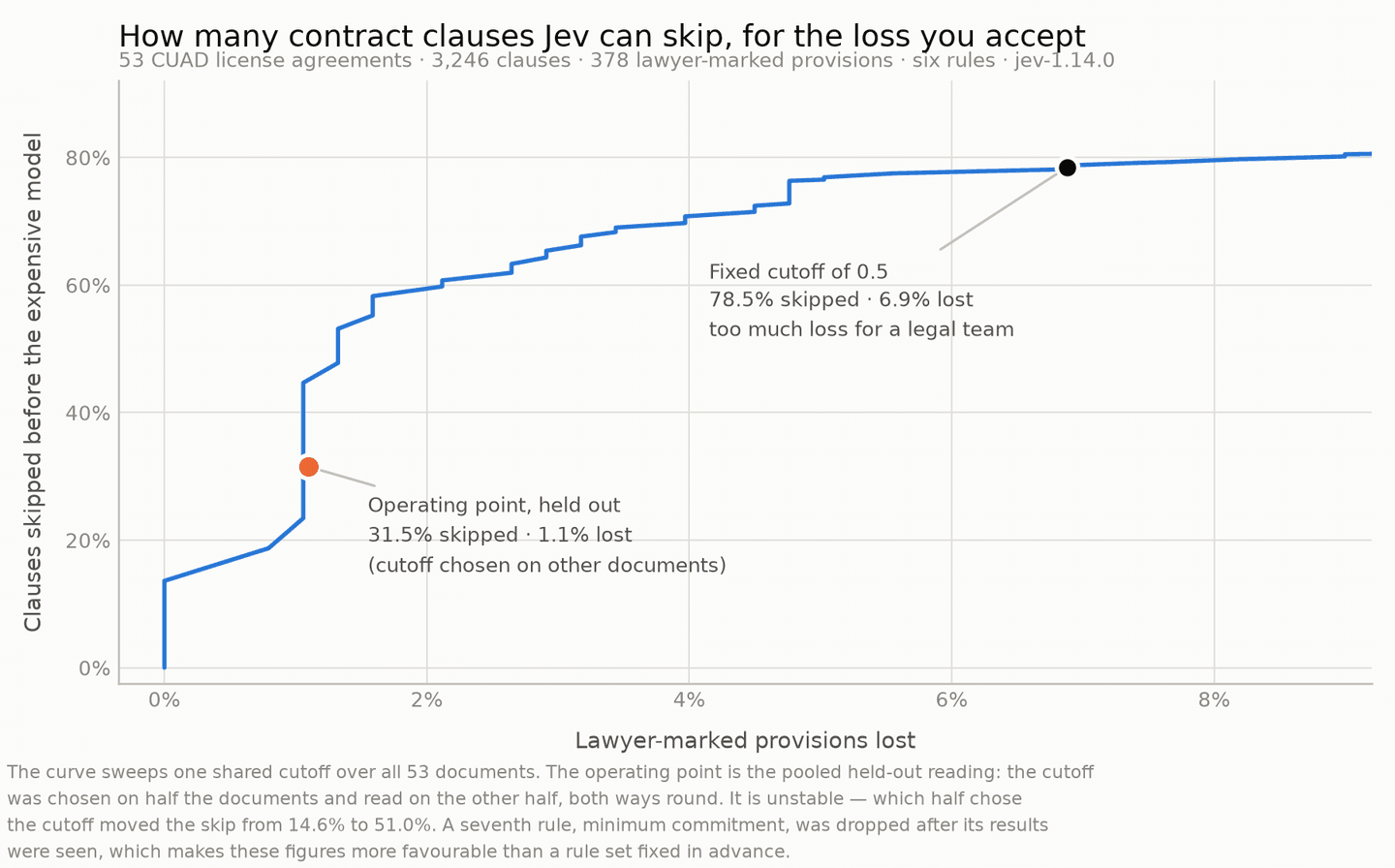
Sending every clause of a contract to an expensive model pays for a lot of reading that finds nothing. Mukammed Alimbet had Jev read each clause of 53 license agreements against six rules and skip the clauses it rejected on all six. With the cutoff aimed at losing 1% of the provisions lawyers had marked, Jev skipped 31.5% of the clauses and lost 4 of 378 (1.1%).

Results

How much Jev skipsdepends on the loss you accept.

A clause is skipped when Jev’s probability of yes is below the cutoff for all six rules. The cutoff was chosen on one half of the documents and read on the other half, both ways round, so every document is reported once.

  • 31.5%of the 3,246 clauses skipped (1,023) when the cutoff aimed for a loss of 1% of marked provisions.
  • 4 of 378lawyer-marked provisions sat inside the skipped clauses (1.1%).
  • 64.6%skipped when the aim was 2%, but the loss came out at 4.2% (16 of 378), and at 6.4% on the worse half.
  • 78.5%skipped at a fixed cutoff of 0.5, with 26 of 378 provisions lost (6.9%). Too many for a legal team.
The cutoff trade-off, as the builder drew itThe builder’s own
Line chart of clauses skipped before the expensive model against lawyer-marked provisions lost, as one shared cutoff sweeps all 53 agreements. The held-out operating point is at 31.5% skipped and 1.1% lost; a fixed cutoff of 0.5 is at 78.5% skipped and 6.9% lost. The note under the chart says which half of the documents chose the cutoff moved the skip from 14.6% to 51.0%, and that a seventh rule was dropped after its results were seen.
The builder’s chart, from his repository: one shared cutoff swept over all 53 agreements, with the held-out operating point and the fixed 0.5 cutoff marked. His note under the chart gives the caveats.

A loss of 1% of marked provisions

Clauses skipped
1,023 of 3,246 (31.5%)
Marked provisions lost
4 of 378 (1.1%)
Estimated saving per 1,000 clauses, on reading alone
$0.28 (25%)

A loss of 2% of marked provisions

Clauses skipped
2,097 of 3,246 (64.6%)
Marked provisions lost
16 of 378 (4.2%)
Estimated saving per 1,000 clauses, on reading alone
$0.59 (53.5%)

Claude Sonnet 5.5 was never run. The saving is an estimate from token counts at list prices against sending every clause to it, and it counts only what the expensive model would read. If each of its answers is assumed to be 100 tokens long, the estimate at the 1% aim rises to $4.68 of $7.11 per 1,000 clauses. Jev version jev-1.14.0, run on 13 November 2026. The figures are the builder’s.

What Jev is asked

Six yes-or-noquestions per clause.

Jev is TypeSafe’s System One model, the kind of model most people call a decision model: it answers one narrow question with a typed answer and a probability.

  1. 01

    Six questions, one per rule.

    Does this clause cap or limit a party’s liability? Does it require help or obligations after termination? Does it let a party terminate without cause? Does it grant or require exclusivity? Does it give a right or trigger on a change of control? Does it restrict assigning or transferring the agreement?

  2. 02

    One request per clause.

    All the questions go in a single request, and Jev returns a probability of yes for each: 3,246 requests for the whole set.

  3. 03

    The skip rule is code.

    A clause is skipped only when every one of the six probabilities is below the cutoff. Every other clause goes on to the expensive model, carrying only the questions Jev said yes to.

Where the clauses go, with the cutoff aimed at a 1% lossMeasured
jev-1.14.0, 13 November 2026. The cutoff was chosen on one half of the documents and read on the other, both ways round. The figures are the builder’s.

What it showed

The answer moveswith the documents.

  1. 01

    The two halves disagree.

    At the 1% aim the pooled figure is 31.5%. With the cutoff chosen on one half of the documents, Jev skipped 14.6% of the other half. The other way round it skipped 51.0%.

  2. 02

    A higher cutoff skips far more and loses too much.

    At a fixed cutoff of 0.5, well above the ones behind the 31.5%, Jev skipped 78.5% of the clauses and lost 6.9% of the marked provisions. At that cutoff five rules still catch 92 to 94% of the clauses lawyers marked, and change of control catches 75%.

How it was measured

53 license agreements,marked by lawyers.

  • The documents.

    The 53 license agreements in CUAD, a public set of real commercial contracts in which lawyers highlighted the provisions that matter. They split into 3,246 clauses.

  • The truth.

    The 378 provisions lawyers marked under the six rules. A provision is lost when it sits inside a clause Jev skipped.

  • The cutoff.

    The documents are split in two by a hash of the document id. The cutoff is chosen on one half to keep the loss within the aim, then applied to the other half. Both directions are pooled.

  • The cost.

    Jev’s own cost and time are measured: $0.085 and 179 seconds for the whole run. The expensive model’s cost is an estimate, because it was never run.

Limits

What the testdoes not show.

  • The expensive model was never run, so the saving is an estimate, and most of it rests on an assumed answer length.

  • A seventh rule, minimum commitment, was dropped after its results were seen: the builder found its question narrower than what the lawyers had marked, and a few of its labels look wrong. Dropping it makes the six-rule figures more favourable than a rule set fixed in advance. For all seven rules the builder reports the 2% aim only: 20.5% skipped and 7 of 429 provisions lost (1.6%).

  • The pooled loss of 1.1% is slightly above the 1% aimed for, and the worse half lost 1.8%. Two of the four lost provisions are in one agreement.

  • Jev’s probabilities moved by up to 0.04 between runs on the same question, so the report is rebuilt from stored answers.

  • One contract type and 53 documents.

Code and sources

Read the codeand the tables.

Who built it

The engineerbehind this build.

Mukammed Alimbet

Mukammed Alimbet

Senior AI/ML Engineer · Kazakhstan

Mukammed built the pipeline, ran it on all 53 agreements and wrote up the results, including the rule he dropped.

He is a Senior AI/ML Engineer at ai71. Before that he was an AI/ML Engineer at EPAM Systems and a data scientist and ML engineer at Publicis Groupe, and in 2026 he worked for three months as an AI Engineer at TypeSafe, which makes Jev. He has close to 7 years of industry experience.

Next step

Have a decision like this one?

A short call on what gets decided, how often, and what a wrong answer costs.

Book a call